It’s 10:15 a.m. on a Monday. You’re sitting at your desk. The task in front of you isn’t new. You’ve done it dozens of times before. You know exactly how to start. And yet, instead of beginning, you pick up your phone and start scrolling.
You are not confused. You are not unaware. You know what you’re doing. And that’s what makes it frustrating.
Most people will tell you the issue is willpower. Some will say you lack discipline. Others will label you lazy or unmotivated. But what if none of that is true? What if the real problem is much deeper and far more biological?
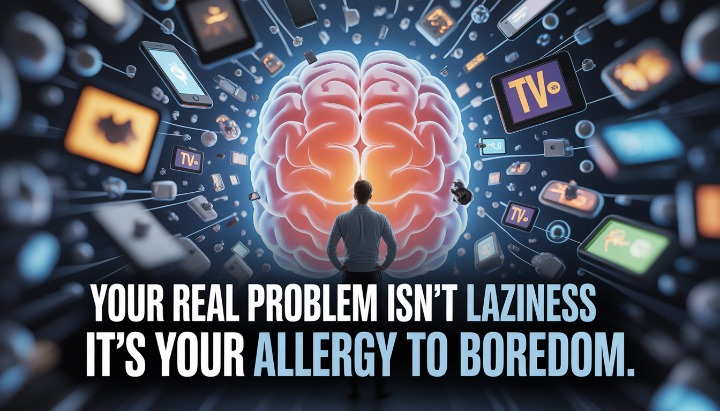
The real problem is that you are allergic to boredom. And that allergy is quietly shaping your career.
This blog isn’t about forcing productivity or squeezing more output from your day. It’s about understanding why boredom feels unbearable, how it sabotages mastery, and why learning to sit with it might be the most powerful career skill you’ll ever develop.
The Excitement Curve That Always Collapses:
Think about the last time you started something new. A job. A side hustle. A YouTube channel. A new skill.
In the beginning, everything feels electric. There is novelty. You are learning. You are experimenting. You feel alive. The possibilities seem endless. You imagine the future version of yourself succeeding at this new path.
But then something shifts, the glamour fades. The tasks become repetitive. The learning curve gets steeper. The results slow down. The work starts to look less like inspiration and more like repetition. This is the exact moment most people quit, not at the beginning. Not when things are exciting. But in the middle, when the mountain becomes visible.
Instead of pushing through that phase, many people jump to something new. A new opportunity. A new skill. A new platform. Maybe YouTube becomes Instagram Reels. Maybe digital marketing becomes copywriting. Maybe freelancing becomes dropshipping.
This pattern has a name: shiny object syndrome.
It’s the inability to stay committed long enough to see the fruits of deep work. It’s the addiction to novelty disguised as ambition, and underneath it all is boredom.
Why Boredom Feels Like a Threat:
Logically, we know that boredom is harmless. Sitting quietly for five minutes will not hurt us. Yet our body reacts as if something is wrong, and restlessness creeps in. We feel the urge to check notifications. To scroll. To consume something. To stimulate ourselves.
There’s science behind this.
When you are not cognitively occupied, your brain activates something called the Default Mode Network. This is the system responsible for introspection, creative connections, processing past experiences, and imagining the future. It’s where deeper thinking happens, but in a world of constant stimulation, your nervous system has been trained to treat stillness as danger.
Notifications. Short videos. Instant messages. Endless content. These have conditioned your brain to expect constant input. So when stimulation disappears, your system panics. It interprets silence as a threat.
A famous study by Harvard psychologist Dan Gilbert illustrated this perfectly. Participants were placed in a room for 15 minutes with nothing to do. The only option available was a button that would deliver a mild electric shock.
They had two choices: sit quietly with their thoughts or press the button and shock themselves. The majority chose the shock. Think about that. People preferred physical pain over sitting alone with their thoughts. This isn’t about weakness. It’s about conditioning.
The Moment Most People Quit:
Let’s say you decide to master a skill. You buy the courses. You order the books. You create a plan. For a few weeks, you are energized. You’re absorbing information like a sponge.
Then comes the realization.
There is a massive gap between where you are and where you want to be. The mountain becomes visible. The repetition begins. The work looks endless. This is the moment your brain tries to protect you.
It whispers, “Maybe there’s something better.” It shows you a new skill that looks easier. A new opportunity that seems faster. A different path that feels more exciting. Your brain isn’t evil. It’s trying to conserve energy. Climbing mountains is hard. Survival systems prefer shortcuts.
So you jump, and every time you jump, you reset the clock. You return to the beginning. You experience the excitement phase again, but never the mastery phase. Mastery dies in the middle.
Mastery Is Endurance Through Monotony:
Many people believe that masters are born with a higher IQ. Natural talent. Unique gifts, but mastery is rarely about talent alone. It is about endurance through monotony. On the outside, mastery looks glamorous. Speaking engagements. Recognition. Results. Success.
On the inside, mastery looks repetitive. Boring drills. Iterations. Refinements. Practicing the same fundamentals over and over, the difference between amateurs and masters is not intelligence. It’s tolerance for boredom.
Masters can sit through repetition without fleeing. They can perform the same foundational tasks thousands of times without seeking novelty. They have trained their nervous system to stop treating boredom as a threat.
What Happens When You Sit With Yourself:
Here’s the uncomfortable truth: the reason you avoid boredom may not just be restlessness. It may be avoidance when you sit quietly, questions surface.
Am I using my potential?
Why am I procrastinating?
What am I afraid of?
Is this path aligned with who I want to become?
These are not easy questions. They require honesty. And honesty can be painful; scrolling distracts you from them. Constant consumption shields you from self-reflection, but when you allow yourself five minutes of stillness, something powerful happens. The Default Mode Network activates. Connections form. Ideas surface insights you were searching for in books or videos, and begin to emerge from within. Often, the life-changing idea you are seeking isn’t hidden in the next podcast episode. It’s buried under the noise you keep feeding yourself.
From Random Thoughts to Frameworks:
When you sit with yourself long enough, your brain begins organizing information in new ways.
You might combine scattered ideas into a clear system. You might connect past experiences to a new direction. You might recognize patterns you previously ignored, but this doesn’t happen instantly. It requires space. The key is not just sitting but capturing.
When an idea surfaces, write it down. When a question arises, record it. Later, analyze it. Ask how it applies to your work or life. If it’s actionable, break it into small steps. If not, store it for later. This transforms boredom from discomfort into strategy.
The Consumption Trap:
In the self-improvement world, we are obsessed with consuming. More books. More courses. More videos. More podcasts, we believe, the next piece of information will unlock everything, but constant consumption can become another form of avoidance.
It feels productive. It feels ambitious. But sometimes it’s just stimulation disguised as growth. There is nothing wrong with learning. The problem begins when input replaces reflection. The insight that changes your life might not come from another source. It might come from you if you allow silence long enough for it to surface.
The Five-Minute Experiment:
You don’t need to meditate for an hour. You don’t need to isolate yourself in a forest.
Start small.
The next time you feel the urge to grab your phone during work, pause. Sit still for five minutes. No music. No scrolling. No distraction.
Observe what happens.
Restlessness will appear. Let it pass. Questions may surface. Notice them. Ideas may form. Capture them.
Some days, nothing profound will happen. That’s fine. The goal isn’t instant genius. The goal is training your nervous system to tolerate stillness.
Because on the other side of boredom lies depth.
On the other side of novelty addiction lies mastery.
On the other side of constant stimulation lies clarity.
You are not lazy. You are not broken. You are overstimulated.
And if you can learn to sit with yourself even for a few minutes, you may discover that the answers you’ve been searching for were never outside of you to begin with.
Conclusion:
The struggle you experience is not a lack of discipline or intelligence; it is a consequence of living in a world that constantly overstimulates your mind. When your brain becomes accustomed to endless novelty, even normal, necessary work begins to feel unbearable. What you interpret as laziness is often just your nervous system rejecting boredom.
But here’s the shift that changes everything: boredom is not your enemy, it is the gateway to depth, mastery, and clarity. The phase where things feel repetitive and slow is not a sign that you should quit; it is a sign that you are moving from surface-level excitement into real growth. This is the phase where most people give up and where a few choose to stay.
Mastery is not built in moments of inspiration. It is built in long stretches of monotony, where you continue showing up even when the work feels dull. The ability to sit with boredom, to resist the urge for constant stimulation, and to focus without distraction is becoming one of the rarest and most valuable skills in today’s world.
At the same time, stillness offers something that constant consumption never can—self-awareness. When you stop running from silence, you begin to hear your own thoughts clearly. You start asking better questions. You discover ideas that are uniquely yours.
You are not lazy. You are overstimulated. And once you retrain your mind to tolerate stillness, everything begins to change. Your focus deepens, your work improves, and your potential finally has the space to unfold.
In the end, the real advantage doesn’t belong to the most talented or the most motivated. It belongs to the person who can stay when things get boring—because that is where real growth begins.
FAQs:
1. Is boredom really the main reason behind procrastination?
In many cases, yes. Procrastination often happens when tasks feel repetitive or unstimulating. Instead of starting, the brain seeks quick dopamine from activities like scrolling or watching videos. It’s less about laziness and more about avoiding discomfort.
2. How can I train myself to handle boredom better?
Start small. Practice sitting without distractions for a few minutes each day. Gradually increase your tolerance for stillness. Avoid instantly reaching for your phone when you feel restless. Over time, your brain adapts and becomes more comfortable with focus.
3. What is “shiny object syndrome” and how does it affect growth?
Shiny object syndrome is the habit of constantly switching to new ideas, skills, or opportunities because they feel exciting. This prevents long-term progress because you never stay consistent long enough to reach mastery in any one area.
4. Can boredom actually improve creativity and thinking?
Yes. When you allow yourself to be bored, your brain activates deeper thinking processes. This can lead to new ideas, better problem-solving, and stronger self-awareness—things that constant stimulation often blocks.
5. How do I balance learning new things without falling into the consumption trap?
Focus on applying what you learn. Limit passive consumption and spend more time practicing or creating. A good rule is to ensure that learning is followed by action, so knowledge turns into a real skill rather than just information.